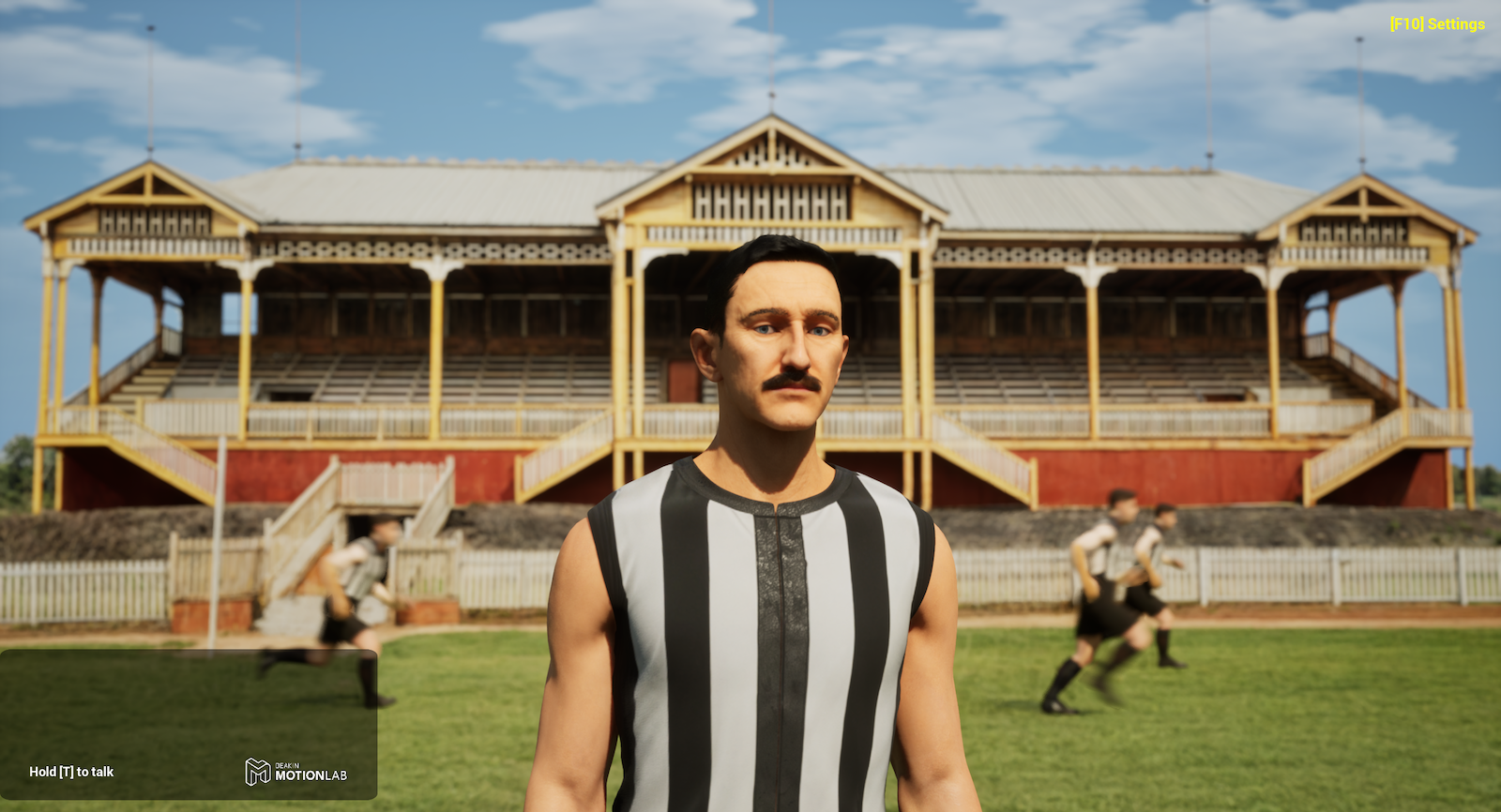

Flapper Said: Exploring the Future of Conversational AI
Presented by Deakin University Library
DETAILS
Free, no booking required
Deakin University Library
221 Burwood Highway, Burwood VIC, Australia
DATES
Thu 14 May 8am – 9pm
Fri 15 May 8am – 9pm
Sat 16 May 8am – 9pm
Sun 17 May 8am – 9pm
Mon 18 May 8am – 9pm
Tue 19 May 8am – 9pm
Wed 20 May 8am – 9pm
Thu 21 May 8am – 9pm
Fri 22 May 8am – 9pm
Sat 23 May 8am – 9pm
Sun 24 May 8am – 9pm
This exhibition investigates how machines speak and how we respond. At its centre is Flapper, a conversational AI based on Les Hughes (1884–1962), the legendary Collingwood Football Club player (1908–1922), affectionately nicknamed ‘Flapper’ for his animated presence on the field and later a celebrated Melbourne/Naarm hotel publican.
Using technology, Flapper is brought into the present, inviting visitors into direct conversation and responding in real time with a mix of thoughtful observations, sharp wit and unexpected depth. Equal parts historian, commentator and comedian, he draws from history, cultural references and computational logic. His answers are informed by online resources alongside anecdotal and factual data specifically coded to reflect what the real Les Hughes might say today.
Emerging from research by Dr Russell Kennedy (School of Communication and Creative Arts and Deakin Motion Lab), Flapper Said explores what AI says and why and how it speaks, raising important questions about authorship, emotion, bias and the desire for machines that understand us.
What does it mean, in an era shaped by generative AI, for a machine to speak convincingly? Who, or what, owns that voice? And how do we respond when the line between human and machine begins to blur?
Flapper Said reflects a moment of collective reckoning. As we create more capable conversational agents, immersive simulations and AI-driven decision systems, we must keep asking: what does it mean to speak, to listen, to understand? And what kind of future are we designing for humans, for machines and for the conversations they will share?