
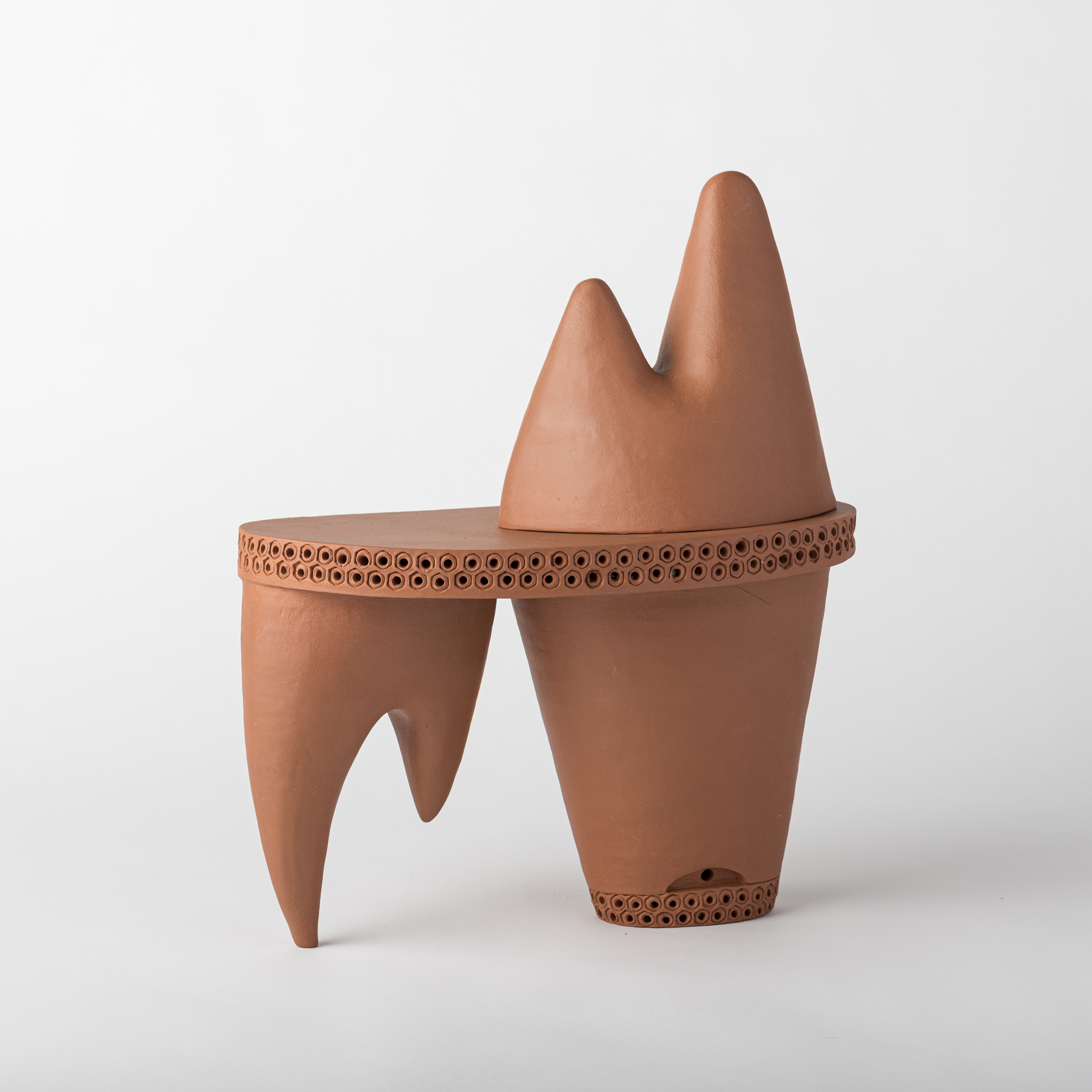
Circular Ceramics for Native Bee Habitat
Presented by Slow Clay Centre
DETAILS
Ticketed
Slow Clay Centre
13 Keele Street, Collingwood VIC, Australia
Do you want to attract native bees to your garden? Do you want to design and make a beautiful ceramic nest for them?
Circular Ceramics for Native Bee Habitat is a one-day hands-on ceramics workshop with award-winning ceramic artist Julie Bartholomew that also launches a citizen science project to attract native bees to urban gardens.
Many native Australian bees, particularly the Amegilla, like to build their nests in raw clay and are vulnerable for a range of reasons. They are also excellent pollinators.
Slow Clay Centre is launching a project that will help close the circle on studio waste clay, reusing it to fill bee homes. The project brings together ceramic clay waste and native bee habitat, providing a model for other Australian ceramic studios.
Our guest artist is the award-winning ceramic artist and bee-lover Julie Bartholomew, who will guide workshop participants to design and hand-build native bee habitat structures that will be placed in participants’ gardens to monitor and report.
This workshop is Part One of a three-stage project. Part Two will be a forum with native bee scientists and habitat designers, and Part Three will be the public launch of the model, which will engage local communities through primary schools.
The model will be shared with ceramic studios through printed articles, digital platforms and social media, forming an ongoing open-source project to encourage participation.
Participants
Julie Bartholomew
Julie Bartholomew completed a PhD in 2006, a Master of Visual Arts in 1999 and previously a Bachelor of Visual Arts from the University of Sydney. Julie has exhibited both nationally and internationally in Japan, Taiwan, China, Korea and New Zealand.Julie was the winner of the International Gold Coast Ceramics Award in 2006 and has been the recipient of five major Australia Council for the Arts grants, the Tokyo Studio Residency, the Australia–China Council Red Gate Residency in Beijing and the Asialink Taiwan Residency. Her work is held in many collections including the National Gallery of Australia, the National Museum of Australia, the Shepparton Art Museum (Victoria), the Shanghai Arts and Crafts Museum (China), the WOCEK International Ceramics Collection (Korea) and the Yingge Ceramics Museum (Taiwan).The ceramics practice of Dr Julie Bartholomew has been inspired by cultural issues and social debates. Over her career, Julie has explored communication technology, global branding and female identity. Since 2010 her work has responded to environmental issues including the precarious existence of threatened Australian birds and flowers, the significance of ice core extraction from Antarctica and, more recently, the declining population of bees.
Slow Clay Centre
Slow Clay Centre (SCC) was established in 1990 as the private school of ceramic artist Jane Sawyer. It significantly expanded in 2012 and now employs a staff of fifteen. Widely regarded as one of Australia’s leading pottery, clay and ceramics education centres, SCC’s mission is to support potters and ceramic artists and to provide deep education about pottery and ceramic art. SCC is passionate about creating an inclusive community for effective, meaningful and personal education for all students.SCC is a school and a community that values clay in a non-hierarchical way — as a medium for personal and cultural expression as much as a profession. SCC also recognises clay as having agency, meaning that it participates in the making relationship.SCC recognises that its work falls within an extractive industry with environmental consequences. The digging of clay, mining of glaze materials, firing of kilns and creation of waste are all part of the macro-economic problem in which safe planetary boundaries are at risk and are already being crossed. The centre’s goal is to create regenerative practices and to educate and support its community to do the same. SCC is constantly reviewing its processes and is a founding member of Clay Matters, a group that researches, explores, advocates and pledges to support best practice. The centre welcomes open discussion in a spirit of mutual development to ensure the latest knowledge is shared among colleagues.