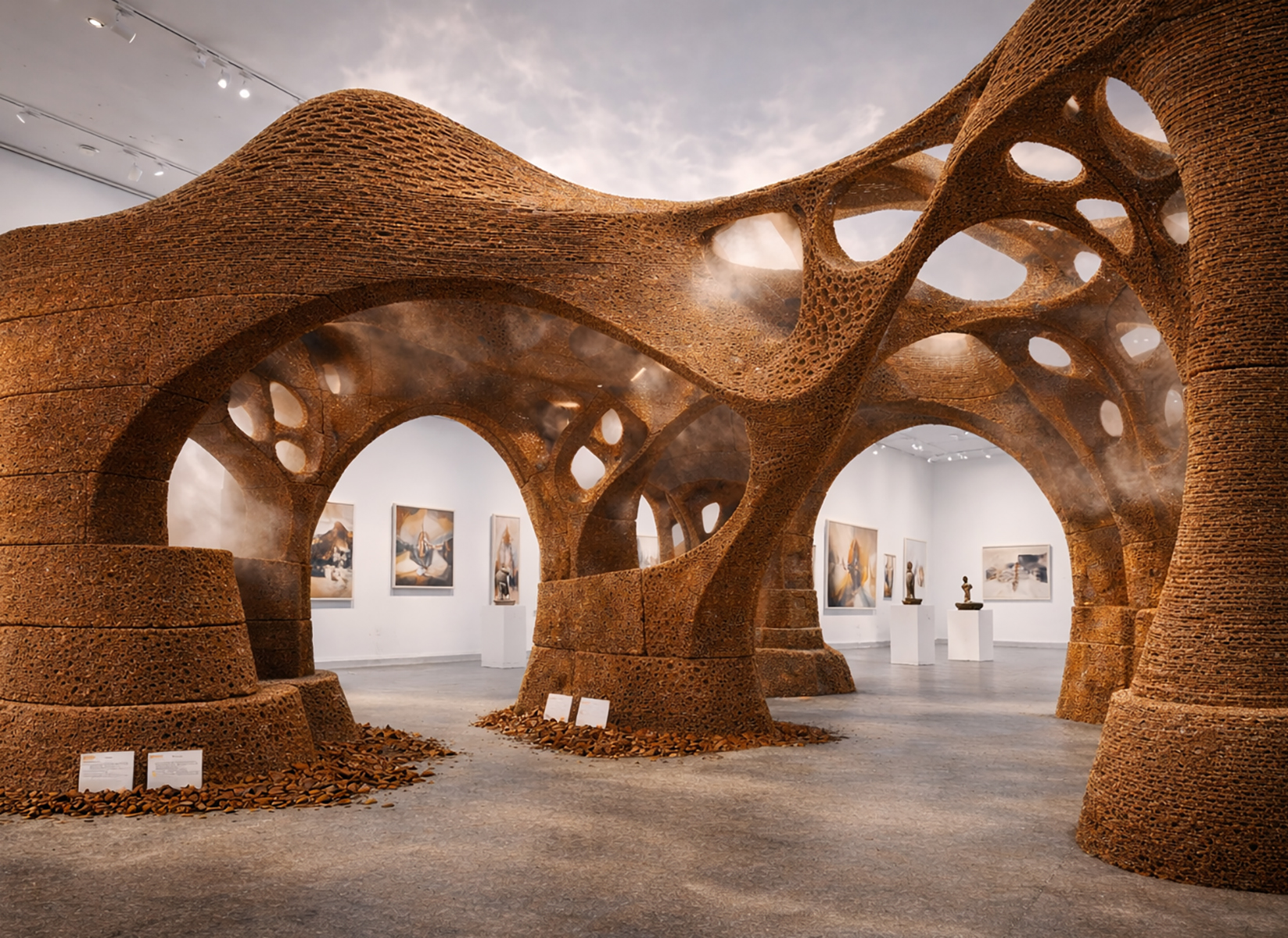
Waste to Form
Presented by Dr Ding Wen ‘Nic’ Bao & Dr Jiahui Li & Kang Liu & Dr Xin Yan & Prof Baohua Jia & Prof Yi Min ‘Mike’ Xie
DETAILS
Free, no booking required
RMIT Building 100 - Design Hub Level 3 and RMIT Building 3 - Foyer Level 1
RMIT University - Melbourne City Campus, La Trobe Street, Melbourne VIC, Australia
DATES
Fri 22 May 10am – 4pm
Sat 23 May 10am – 4pm
Sun 24 May 10am – 4pm
This event presents an immersive, modular 3D-printed installation that reimagines locally collected coffee waste as a material for multisensory architecture. In Melbourne/Naarm, coffee is part of everyday life – yet the spent grounds generated daily by cafés and workplaces are typically discarded. This project diverts that waste stream into a biodegradable 3D-printing filament and assembles it into a spatial demonstrator designed and fabricated at RMIT University, transforming circularity from an abstract sustainability concept into a tangible, visible and experiential condition.
Rather than treating smell as an incidental by-product of material reuse, the installation positions scent as an active design parameter – co-designed alongside surface texture, porosity and geometry to choreograph atmosphere, tactility and perception. Scent is calibrated and becomes part of the architectural brief.
The work is developed through a cross-disciplinary collaboration between the School of Architecture and Urban Design, the School of Science and the School of Engineering at RMIT University, in partnership with Hohai University and Beijing University of Civil Engineering and Architecture.
FormX Research Lab leads computational design, modularisation and fabrication-aware geometry generation, introducing a parametric ‘roughness spectrum’ that systematically varies micro-relief, grain exposure and internal porosity while maintaining printability, structural coherence and repeatable robotic toolpaths.
In parallel, the Centre for Atomaterials and Nanomanufacturing (ACAN) advances material formulation and characterisation, establishing controlled processes for coffee-ground pre-treatment and biopolymer compounding to enable consistent prototyping, performance testing and lifecycle assessment.
Meanwhile, the Centre for Innovative Structures and Materials (CISM) provides advanced structural modelling and experimental validation, evaluating stiffness, load transfer mechanisms and long-term material behaviour under varying environmental conditions. Through digital simulation and physical testing, CISM ensures that the modular system balances sensory porosity with mechanical reliability, bridging structural intelligence with material circularity.
A family of 3D-printed modules forms the installation, allowing visitors to compare variants and directly experience how geometry reshapes sensory qualities. Differences in surface articulation and internal void configuration influence acoustic diffusion, tactile perception and scent diffusion profiles. The installation is supported by research into acoustic behaviour, tactile preference and scent persistence over time.
By linking parametric design variables to measurable and perceived experience, the project expands computational design beyond conventional metrics of strength, efficiency and cost — toward a multisensory, circular and human-centred paradigm. It proposes a new generation of interior systems that are biodegradable, fabrication-aware and embedded within everyday urban material cycles.
Led by Dr Nic Bao, Prof Baohua Jia and Prof Mike Xie, with Dr Jiahui Li, Dr Xin Yan and Kang Liu, the project forms part of a broader Australian Research Council (ARC) research agenda exploring intelligence-empowered circular materials, computational fabrication and next-generation sustainable built environments.
Participants
Dr Ding Wen 'Nic' Bao
Dr Dingwen 'Nic' Bao is a Senior Lecturer in Architecture at RMIT University, serving as Architecture Technology Stream Coordinator and Director of the FormX Research Lab. He is a Chief Investigator on a RACE-funded project, Project Leader within the ARC Advanced Timber Hub and an Affiliated Scholar of the ARC Centre for Next-Generation Architectural Manufacturing. Dr Bao specialises in advanced architectural and computational design, topology optimisation, behavioural algorithms, additive manufacturing and robotic fabrication. His research integrates performance-driven design with intelligent construction to advance sustainable, digitally enabled built environments. He is a registered architect in Australia and the US, and a RIBA Chartered Architect (UK).Beyond academia, he is Director of BWA Architects and a partner at Ameba. He also serves as Secretary of CAADRIA and the DigitalFUTURES Association, Co-Chair of the 2026 Computational Design & Robotic Fabrication International Conference, and Deputy Chair (VIC) and National Lead for Digital Design & Building Technology at Prefab Council Australia (PCA).
Dr Jiahui Li
Dr Jiahui Li is a Strategy Innovation Manager at RMIT University’s ARC Research Hub for Intelligent Energy Efficiency in Future Protected Cropping (E2Crop). He leads strategic innovation initiatives, facilitates industry collaboration and supports interdisciplinary research development to deliver impactful and translational outcomes. His role includes managing research partnerships, intellectual property and agreements, identifying funding opportunities and enhancing the Hub’s global visibility in sustainable resource recovery and circular economy solutions.Previously, Dr Li was a Postdoctoral Research Assistant at RMIT University, where his research focused on nanomaterial-enhanced 3D printing technologies. He completed his PhD at Swinburne University of Technology, specialising in advanced additive manufacturing and material performance optimisation, and also worked as a Research Assistant and Laboratory Instructor.His expertise spans additive manufacturing, nano-engineered materials, computational simulation (including Abaqus) and research translation, bridging engineering innovation and strategic research management.
Kang Liu
Kang Liu is a PhD Candidate in Architecture at RMIT University and a Research Assistant at the FormX Research Lab. He holds a Master of Architecture from RMIT University and works as an Architectural Designer at BWA Architects. Prior to this, he worked at Archi-Union Architects, where he gained experience in experimental design and innovative architectural practice. His research interests focus on computational design, and 3D printing for architecture. He specialises in parametric modelling, digital fabrication workflows and robotic additive manufacturing. His work aims to develop intelligent, sustainable and fabrication-aware architectural systems.
Dr Xin Yan
Dr Xin Yan is currently a Lecturer at the School of Architecture and Urban Planning, Beijing University of Civil Engineering and Architecture (BUCEA). He previously worked as a postdoctoral researcher at the Future Lab, Tsinghua University. He received his Bachelor of Mechanics from the University of Science and Technology of China, and his Master’s and PhD in Architecture and Engineering from the University of Chinese Academy of Sciences. He was also a Visiting Scholar at the Centre for Innovative Structures and Materials (CISM), RMIT University.Dr Yan is the co-founder of the X-FORM Research Laboratory (XF-RL). He is a member of the International Association for Shell and Spatial Structures (IASS), Secretary of the Committee of Research Architecture under the Architectural Society of China, and Deputy Secretary-General of the Resilient Cities and Architecture Committee of the Architectural Society of China.His research focuses on architectural form-finding, design-oriented topology optimisation and computational methods for innovative structural systems.
Prof Baohua Jia
Distinguished Professor Baohua Jia FTSE FAIP is a globally recognised leader in photonics and nanomaterials innovation. She is a Distinguished Professor in the School of Science at RMIT University and the inaugural Director of the Centre for Atomaterials and Nanomanufacturing (ACAN). She joined RMIT in 2022 as a full Professor and Australian Research Council Future Fellow (Level 3).Professor Jia is an elected Fellow of the Australian Academy of Technological Sciences and Engineering (FTSE), the Australian Institute of Physics (FAIP), Optica (formerly OSA) and the Institute of Materials, Minerals and Mining (IoM3). Her interdisciplinary research focuses on fundamental light–nanomaterial interactions, particularly laser manipulation of two-dimensional materials.Her work has enabled the design and fabrication of functional nanostructures for clean energy harvesting and storage, environmental purification, ultrafast optical communication, imaging, spectroscopy and intelligent manufacturing. Widely published in leading international journals, she is recognised for translating advanced photonics technologies into sustainable real-world applications.
Prof Yi Min 'Mike' Xie
Professor Yi Min 'Mike' Xie AM FTSE CAE is an Honorary Professor at RMIT University and Professor and Dean of the College of Future Technologies at Hohai University, China. He was an Australian Laureate Fellow and previously served as a Distinguished Professor at RMIT. He pioneered the Evolutionary Structural Optimisation (ESO) and Bi-directional Evolutionary Structural Optimisation (BESO) methods, now widely adopted worldwide to design innovative, material-efficient and high-performance structures.Professor Xie is a Fellow of the Australian Academy of Technological Sciences and Engineering (FTSE) and an International Member of the Chinese Academy of Engineering (CAE), and was appointed a Member of the Order of Australia (AM) for significant service to higher education and civil engineering. He is among the most highly cited researchers in structural optimisation and has collaborated extensively with leading international industry partners.