Counterfactual Cities: Regenerative Urban Imaginaries
Presented by Super Urban Lab
DETAILS
Free, no booking required
Exhibition at RMIT Design Hub and various locations; Symposium at RMIT Design Hub
Building 100 (Design Hub) - RMIT University, Victoria Street, Carlton VIC, Australia
DATES
Thu 14 May 9am – 5pm
Fri 15 May 9am – 5pm
Sat 16 May 9am – 5pm
Sun 17 May 9am – 5pm
Mon 18 May 9am – 5pm
Tue 19 May 9am – 5pm
Wed 20 May 9am – 5pm
Thu 21 May 6 – 8pm
Symposium
Fri 22 May 9am – 5pm
Sat 23 May 9am – 5pm
Sun 24 May 9am – 5pm
ACCESS
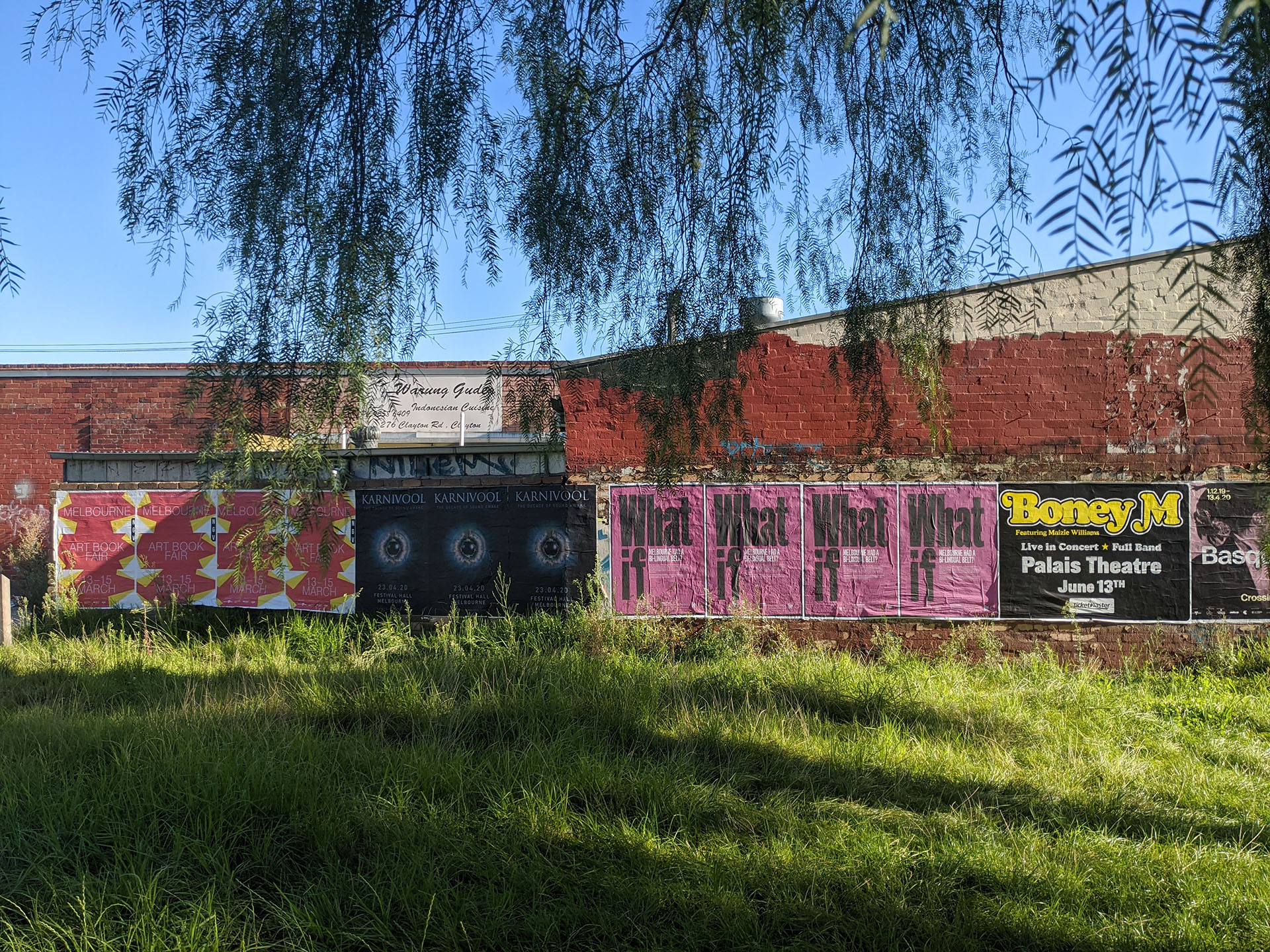
What if regenerative urban futures were not exceptional visions, but the underlying protocol of urban systems?
Counterfactual Cities is an interactive platform comprising a city-wide poster series, on-site discussions and a symposium that explores how architecture and urban design might shift cities from extractive systems to restorative ones. It asks how buildings, streets and infrastructure could operate as circular, adaptive and productive urban ecologies.
Building on the acclaimed Counterfactual City projects (Melbourne Design Week, 2020 and 2021), this new iteration advances a series of radical ‘What if?’ propositions oriented towards regenerative futures.
What if the future of regenerative cities does not emerge from exceptional projects, but from transforming the average? What if every greenfield development was required to heal more than it harmed? What if there was a Special Economic Zone for cultural infrastructure? What if social and environmental comfort was not determined by performance standards? What if cultural memory was encoded in cryptographic supply chains?
Through these counterfactual scenarios, the project uses speculation to explore how planning frameworks, energy systems, digital tools and regulation shape the possibilities of urban life.
The program unfolds across multiple formats. A curated poster series will be installed in prominent locations throughout the city, each responding to the specific contexts and themes it addresses. These interventions extend the discussion into the public realm, embedding speculative propositions directly within Melbourne/Naarm’s urban fabric.
The project also incorporates a series of short, informal discussions and a symposium that moves through transitional and residual urban spaces — including thresholds, interstitial zones, circulation corridors and overlooked margins — within the RMIT Design Hub, the surrounding campus and nearby station precincts.
By intentionally inhabiting these overlooked spaces, the event highlights their potential civic role and suggests new possibilities for everyday urban environments.
Through debate, speculative design and site-responsive interventions, Counterfactual Cities brings together research, professional practice and public discussion. It invites designers, policymakers and citizens to reconsider the infrastructures that underpin urban life, and to imagine how cities might transition from consuming resources to producing energy, equity and care.
Participants
Alexander Moorrees
Caitlyn Parry (Studio Neon)
Claire Scorpo (Agius Scorpo Architects)
Graham Crist (Antarctica Architects)
Helen Duong (PANDA)
Ian Nazareth (TRAFFIC)
John Doyle (Common)
Mark Jacques (Openwork)
Peter Brew (Architect Brew Koch)
Tom Muratore
Vicky Lam
Super Urban Lab
Super Urban Lab is a multidisciplinary cluster within the RMIT University School of Architecture & Urban Design that explores future scenarios for buildings and cities through architectural and urban design practice.